
What Kind of Memoir Will You Write?
What Kind of Memoir Will You Write?
When you are starting out with your memoir, do you ever think, ‘Oh, this is the shape of it?’ or do you simply want to put pen to paper and write it?
A memoir is never a cradle-to-grave inventory of everything that has ever happened to you.
We know an autobiography records the broad sweep of a life from birth onwards – infancy, school ties, career milestones, all the way to old age. A memoir does something far more daring and interesting: it carves out a very deliberate slice of life, chosen with intention. It is not an archive of facts to somehow justify your existence; it is a focused journey through a specific period, a transformation, or something that reshaped who you are.
And you, dear writer, have one task when you sit down to write, and that is to find the right slice. Which, let’s be honest, can be quite the conundrum when you have half a dozen slices all shouting for your attention at once.
Pure Story vs. The Hybrid: The Trap of Early Teaching
Before we look at the buckets, shall we have a talk about what kind of book you are mulling over in your mind right now?
There are two types of memoir to consider – pure and hybrid, and which you choose depends on many factors.
In a pure memoir, you stay strictly inside the skin of the story. You let the events and your experiences speak for themselves. You do not step out of the scene, pull a whiteboard towards the camera, and explain to the reader what it all meant. You honour the lived experience.
Then there is the hybrid memoir. This is a book that tells the story, then turns to face the reader directly to offer something practical: a framework, prompts, a ritual, an exercise, recipes, or poetry drawn from the fire you have walked through.
A lot of writers set out intending to write a hybrid because teaching feels safe. When a memory gets raw, messy, or uncomfortable, our natural defence mechanism is to scramble up into our heads and start dispensing advice: ‘And here are three things I learned about resilience when the bailiffs arrived.’
I adore hybrid memoir, and as much as I do, I am going to suggest that right now you resist the urge.
When I wrote Dancing with Dark Angels, it began as a collection of short stories. They were in chronological order, but there wasn’t a golden thread or core message. They were a collection of stories from over many years.
I published the book and, a year later, unpublished it. I felt it had done its work, and that was healing me. I felt some shame that this was my life – those snippets were evidence of this.
But later, as I was mapping out Journey of the Heart, I thought, what if I added a self-help layer to this and it could be the prequel. (Look at me, all movie director…)
When I wrote Words From The Wild, the story had to be mapped out and written first. I had the Write From The Wild methodology brewing, but I couldn’t write the teaching until the narrative was finished. And honestly, the methodology was not easy – I had so many different things I had been teaching. What helped was looking at how my teaching had evolved and how it could be put to better use.
My message is: If your book is destined to become a hybrid, that is wonderful. But get the story down first. Do not let your inner teacher rescue your narrator from feeling the mess. Once the draft exists, you can return and see what wants to be created.
Writing changes you, and even if you have a clear idea of what you want to teach, often that will change when you see your story in the flesh.
The 9 Shapes of Memoir
Human lives are wildly diverse, but the stories we tell about them tend to gather in distinct clusters. Understanding which shape your story wants to take isn’t about boxing yourself in; it’s about understanding that your memoir will have a flavour or two.
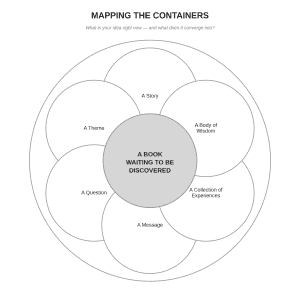
I pulled together nine buckets of ideas for you:
Here are the nine primary containers:
1. The Illness or Healing Memoir
- The Premise: The body goes wrong, and life grinds to a halt. It is a forced pause where physical breakdown demands psychological, emotional, or spiritual reconstruction – or all three.
- What Your Reader Longs For: They want to see how you survived the sense of betrayal by your own flesh. They are looking for honest survival: how to inhabit the wreckage when a perfect recovery isn’t on the cards.
- The Trap to Avoid: Writing a clinical summary. Readers don’t need a medical chart of every prescription and appointment; they need the emotional climate of the waiting room and the shifting sense of self.
In 2018, when my spine fractured while I was very incapacitated, I wrote about healing osteoporosis naturally. I wrote some of my story, but mostly it was the how, and I never did publish it, but it helped me enormously.
2. The Grief Memoir
- The Premise: A person, a relationship, a home, or a fundamental identity dies. The survivor is left standing in the void, tasked with figuring out how to live in the empty space.
- What Your Reader Longs For: Companionship in the dark. Grief is profoundly isolating; readers want to sit beside someone who has borne the unbearable without resorting to trite, platitudinous silver linings.
- The Trap to Avoid: Rushing to the resolution. If you wrap profound bereavement in a tidy package of ‘everything happens for a reason’, you break trust. Let the grief be as heavy, messy, and complicated as it actually was.
3. The Addiction & Recovery Memoir
- The Premise: The oldest story there is, and it still works: the seductive descent, the rock bottom, and the unglamorous, knuckle-whitening climb back towards the light.
- What Your Reader Longs For: Unflinching honesty over ego. Readers of recovery stories possess a ferocious radar for self-deception; they want radical truth, dark humour, and zero posturing.
- The Trap to Avoid: Glorifying the chaos in the first two-thirds of the book and condensing the difficult, boring work of daily sobriety or recovery into a hurried final chapter.
Girl Walks Out Of A Bar by Lisa F. Smith is a great example of this kind of memoir. I read it trying to understand my father’s alcoholism.
4. The Family or Parent Memoir
- The Premise: Digging into the roots to understand how your family works or not. Going back into the trenches of childhood to figure out how inherited patterns, secrets, loyalties, and family shit shaped you.
- What Your Reader Longs For: The transition from the bewildered child to the adult standing before them. The power here comes from seeing your parents as flawed, complex, vulnerable human beings rather than monsters or saints.
- The Trap to Avoid: Using your writing as a courtroom – where you are judge and jury. Memoirs written purely to settle old scores or prove yourself right always feel empty. You must be willing to examine your own complicity in the family dynamic.
I know a lot of women who have estranged children, and this would be a perfect place to go backwards and forwards to share their pain and understanding.
5. The Coming-of-Age Memoir
- The Premise: The weird years. That concentrated span of youth, adolescence, or early adulthood where you crossed the threshold from innocence into experience, examined from the wiser vantage point of who you eventually became.
- What Your Reader Longs For: The ache of discovery. The nostalgia of first loves, bitter betrayals, bad haircuts, and the universal torment of carving out an identity separate from your origins.
- The Trap to Avoid: Generalised nostalgia. What makes coming-of-age sing is ruthless specificity: the odd smell of the school corridor, the tape stuck in the cassette deck, the taste of humiliation.
This always reminds me of both my misspent youth and the tales of feeling so agonisingly alone, ugly, and endlessly listening to At Seventeen by Janis Ian.
6. The Place or Travel Memoir
- The Premise: Your setting is your fate. The place you are isn’t just scenery or a picturesque backdrop; the terrain is an active character that pushes, confronts, breaks, or changes you.
- What Your Reader Longs For: Sensory immersion. The reader wants to feel the orange dust between their toes, smell the scents of nature after rain, the way the land dictates the rules of your daily existence, the barriers and the beauty.
- The Trap to Avoid: The holiday slideshow. A place or a travel memoir is not an itinerary or a description of home. The external journey or surroundings need to somehow show your internal transformation.
This could be my journey from discovering my husband’s double life and living on the outskirts of a city to rural Spain, and how that has most definitely changed me.
7. The Vocation Memoir
- The Premise: The work, the calling, the thing you absolutely had to do – and what it took out of you. A look behind the curtain of a world, trade, or obsession.
- What Your Reader Longs For: Insider access. Readers love trade secrets, arcane vocabulary, the grease and grit of a craft, and the human cost of devotion to an all-consuming path.
- The Trap to Avoid: Talking down to the reader or disappearing into dry technical jargon. Every procedural detail must serve the human stakes of the story.
8. The ‘Life Has Ruptured’ Memoir
- The Premise: The sudden divorce, the midnight evacuation, the bankruptcy, the day the doctor phoned with that news. The day the world as you understood it collapsed, and you had to rebuild a functioning life from scratch from whatever debris remained.
- What Your Reader Longs For: Authority in the ashes. Think of the phoenix rising. The reader wants to see how you coped when the bomb blew up your life, and how you laid the foundations for a new way of being.
- The Trap to Avoid: The victim loop. It is tempting to spend hundreds of pages detailing the cruelty of the rupture. While readers do like the ‘oh my god’ moments, what readers are actually invested in is the messy, stumbling reconstruction.
I think I can safely say I have had many rupture moments. Let’s hope that it’s all behind me now in book format.
9. The Spiritual or Awakening Memoir
- The Premise: The sometimes inconvenient business of waking up. A disruption of long-held dogmas, a loss of faith, a brush with the inexplicable, or a taking apart of the persona you spent decades constructing.
- What Your Reader Longs For: Intellectual and spiritual courage. The willingness to admit you were wrong, to sit comfortably in mystery, and to question the rules you were taught to live by.
- The Trap to Avoid: Preaching enlightenment. The moment an author acts like a guru who has arrived at the summit, the memoir dies. Stay the traveller, stumbling along the path.
The Memoir Shape Inside Another
What you are probably thinking is, ‘mmm, I don’t quite fit one shape ’, and you’d be right. The magic is spotting and embracing the shape hiding inside another.
A memoir might look on the surface like a Place/Travel story, but underneath it is about surviving Grief and how the place you are now in perhaps gave you a crisis of identity, and you had to grieve who you were (that sounds like me). Another might appear to be a vocation memoir about building a business, while the true beating heart is the devastating pain of a ruptured marriage.
My own stories almost always tend to be a rupture sitting inside a healing, or a healing unfolding in the middle of a rupture. But there is always rupture, and I would say a grieving.
When you know both your primary bucket and your secondary, your story finds its backbone, and from there you can map out the foundations. The beauty here is that you can stop wandering off into irrelevant anecdotes, because you know what the story is about, and you know how it unfolds.
Finding Your Story’s Shape: An Exercise
Grab a pen and your notebook, and run your current manuscript or book idea through these three diagnostic prompts:
- Pick your main bucket: Which of the nine shapes holds the emotional core of what you lived through?
- Pick your other bucket: Which secondary shape provides the setting, vehicle, or external momentum?
- Complete the formula:
‘At its core, my book is a [Primary Shape] memoir, hidden inside a [Secondary Shape] story.’
Over to You
What shape does your story take? I’d love to hear more and invite you to join the Soul Writers Lounge. And if you are ready to plan your memoir, there’s a planner or a smaller guide.